What a generated graph should preserve
How can generated graphs preserve the structures that distinguish real network domains, and how can generation be steered towards a target class?
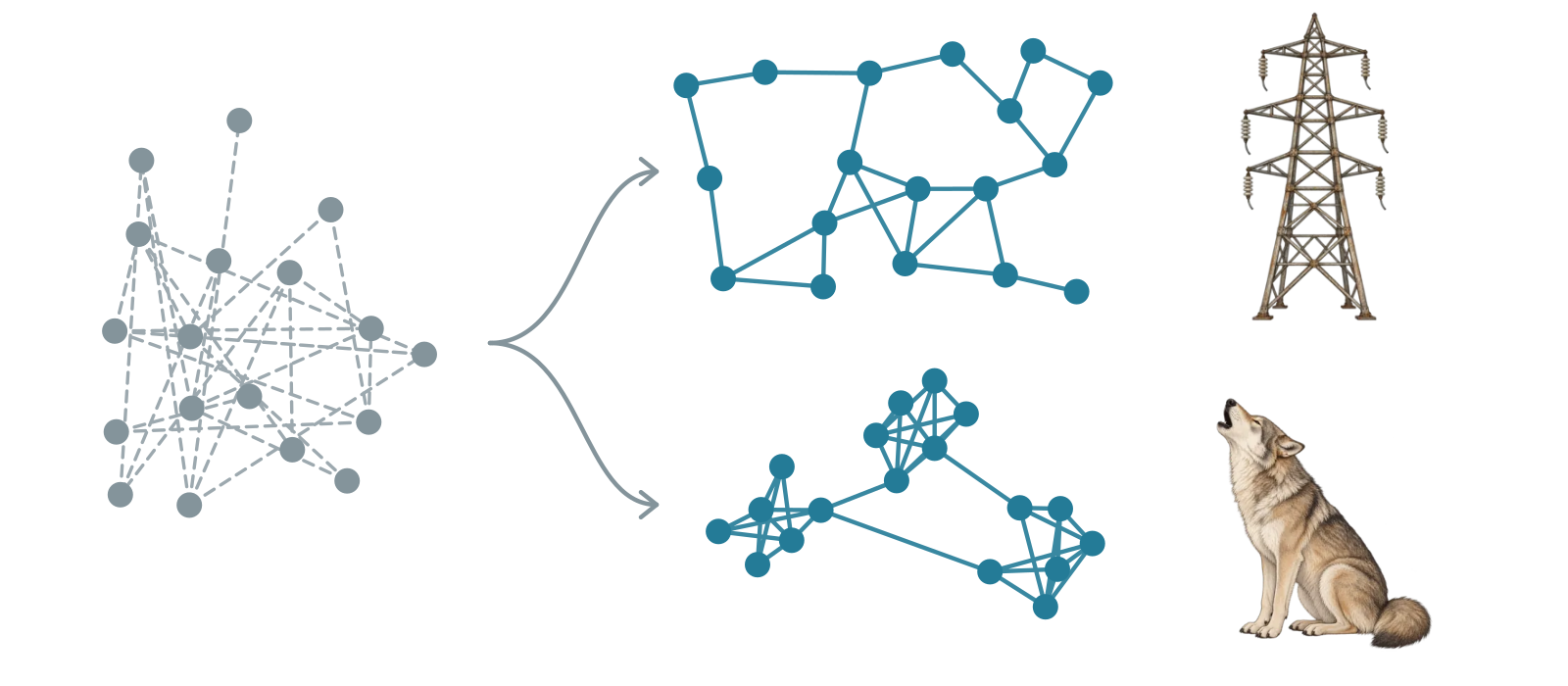
Generating graphs with plausible summary statistics does not guarantee that they retain the structural characteristics of a real network domain. Our work examines both how to evaluate this correspondence and how to guide generation towards a specified class of networks.
Beyond MMD introduces representation-aware evaluation using geometric deep learning. Its comparison of graph generators shows that agreement on selected topological statistics can coexist with a loss of the structural features that distinguish graph domains.
ProtoGuide uses a learned graph representation and target-class prototypes to guide a frozen discrete graph generator. The guidance can be retargeted by changing the prototype without retraining the generator. Experiments with two generative backbones show improved target-class fidelity, with effects on coverage and diversity that vary across classes and settings.
Both selected papers are preprints. Together they address a common question: what should a generated network preserve beyond a small set of summary statistics?